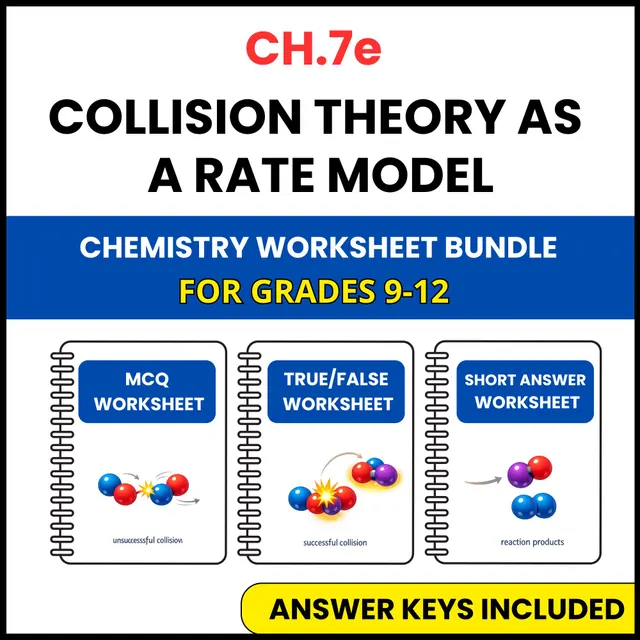
Help your students build real understanding of collision theory as a rate model through ninety questions that move from basic recognition to genuine reasoning about chemistry concepts.
Sample questions include "What effect does increasing the size of solid reactants have on reaction rate?", "Which of the following best describes a reaction that occurs quickly?", and "In a chemical reaction, why is it important to consider both collision frequency and effectiveness?"
Because the three worksheets share the same content in three different formats, you can spread them across the week: one for diagnosis, one for practice, and one for assessment, without repeating a single question.
This set is part of a standards aligned chemistry unit. The unit also covers Heat Energy and Particle Level, Tracking Energy Changes in Matter, Reading Heating Curves for Energy, Phase Changes and Energy, Endothermic and Exothermic, and Evidence for Energy Direction, all in the same three worksheet format, so your classroom routine stays familiar while the topic changes.
Suitable for Grade 9-12 chemistry classes, and for review at any point in the school year. This set is aligned to Virginia SOL standard CH.7e.