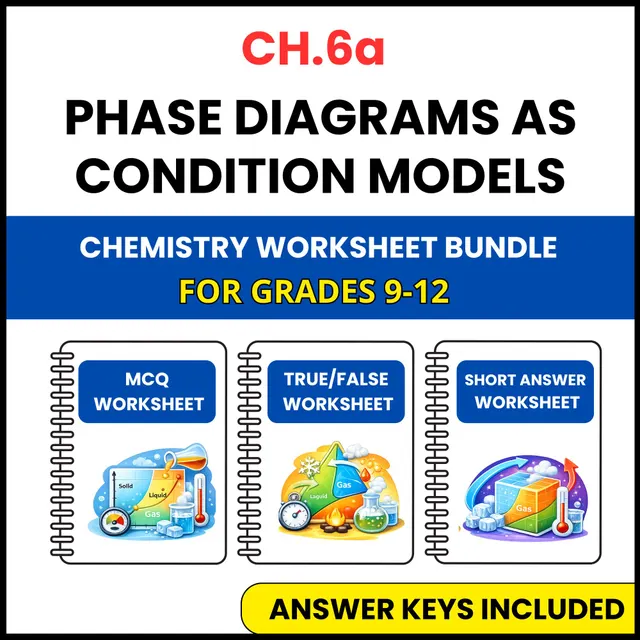
This resource turns phase diagrams as condition into a complete, ready to use review for Grade 9-12 chemistry, covering the same idea from three different angles.
The set includes questions like "Why do some substances have a negative slope in their solid-liquid phase boundary?", "What happens to a substance at the melting point in a phase diagram?", and "What is the significance of the critical temperature in a phase diagram?"
All three worksheets cover the same topic in different question styles. That means you can use one as a pretest, another for practice or homework, and the third as a follow up quiz, without students ever seeing the same question twice.
This set is part of a standards aligned chemistry unit. The unit also covers Temperature and Pressure Define, Phase Changes from Conditions, Gas Laws as Predictive, Solving Gas Law Problems, Interpreting Gas Law Trends, and Intermolecular Forces, all in the same three worksheet format, so your classroom routine stays familiar while the topic changes.
Suitable for Grade 9-12 chemistry classes, and for review at any point in the school year. This set is aligned to Virginia SOL standard CH.6a.